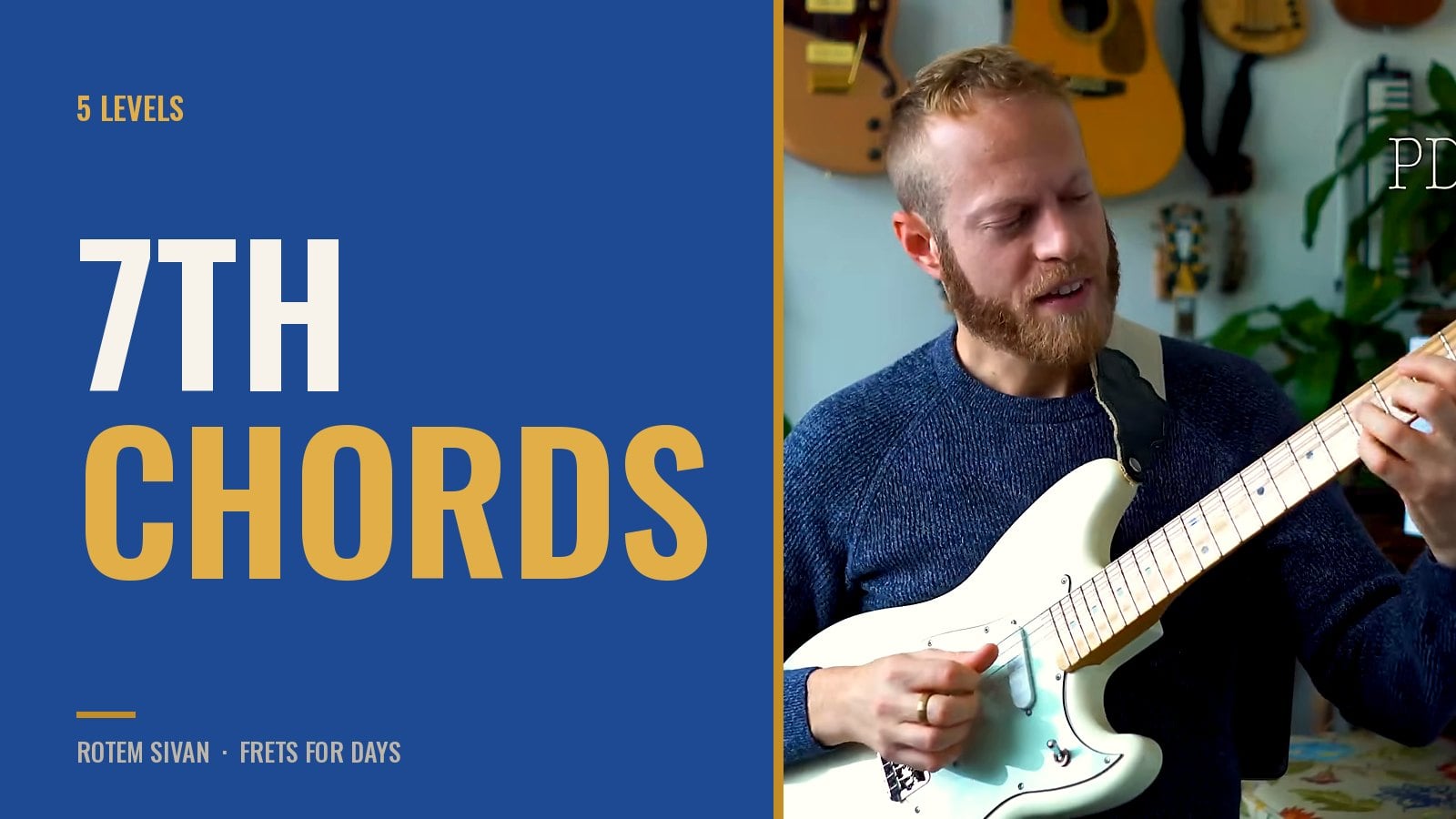
A 7th chord is a triad with one more note: the 7th, counted up from the root. C major is C, E, G, so C major 7 adds B natural. On guitar, start with the shape, then harmonize the C major scale on top of the chord, groove on it, and slip a passing diminished chord between its inversions.
I love chords. One of the things I like is how lush they sound, but they could be even lusher. This lesson goes through five levels to expand your vocabulary with one chord, C major 7, from the basic shape to improvising with it.
What are 7th chords on guitar?
Take a 1, 3, 5 and add the 7. Where does the 7 come from? Literally counting up from the center: 1, 2, 3, 4, 5, 6, 7. You grab the seventh degree.
In the key of C major, the one chord is C. Grab C major, the 1, 3, 5, add the 7th, B natural, and you’ve got C major 7: C, E, G, B. That’s level 1. In the video I also show one voicing to avoid and the one to play instead.
C major 7 is one of four common 7th chord colors. Build them all on C and listen to how each one changes the color:
- Major 7. C, E, G, B.
- Dominant 7. C, E, G, B flat.
- Minor 7. C, E flat, G, B flat.
- Half diminished. C, E flat, G flat, B flat.
If you want compact, movable major 7, minor 7 and dominant 7 shapes from the 6th and 5th strings, the shell chords lesson covers them. The rest of this lesson stays on C major 7 and makes it move.
Level 2: harmonize the C major scale over the chord
Play the C major scale as a melody on top of the C major chord, one note at a time, and find a chord shape for each note. That’s where the cool tensions and extensions show up.
It’s cool that we can play one shape, but what happens if we want to play a different melody? First, these shapes need to be as flexible as we can make them. When I think about C major 7, I see the C major scale all across the board, and I can grab notes from it.
- C. Just let it be for now.
- D. Use a shell chord, the 1, 3 and 7, with D on top. Super beautiful.
- E. The third note of the scale, with its own shape.
- F. It’s going to be a little clashy, but if it’s resolving to the E, it’s going to sound good.
- G. A shape with a first-finger barre.
- A. Strum the whole chord and you get the D as well, so it’s C major 6/9.
- B. A C chord shape with B natural on top.
- C again. Back home. Go through it once more slowly and sing it. You’ll feel the tension.
This matters because I’d like to be as free as I can to write, to explore and to express whenever I’m doing things with music. This framework is really helpful for creating, because you start seeing different notes around the fretboard, and then you can create more.
Level 3: groove on one chord, slowly and in time
Use the same framework, but now play it in time. Groove gently on C major 7 and grab notes around it.
The idea is to groove just ever so slightly on one chord and see what you can find around it using the C framework. Visualize the C major scale across the guitar. The more shapes and fingerings you know for C major, the more things you can grab.
Level 4: add a passing diminished chord between inversions
Put a diminished chord between C major 7 and its next inversion. B diminished over D slides you from C major 7 into C major 7 in first inversion.
That diminished chord fills the gap a little and gives you a little motion. It’s used a lot in classical music, in jazz, in pop, in almost everything. You hear it a lot in church music, definitely that organ sound. For us I think it’s a really cool concept.
For me this has all been just a C major chord, but that feel gives us this motion, this melody, and the bass that is changing, that inversion, is really, really cool.
Rotem Sivan
Then keep going with it:
- C major 7. Root position.
- B diminished over D. B diminished in first inversion, the passing chord.
- C major 7 over E. First inversion.
- F diminished. I’m still thinking of it as B diminished, inverted.
- C major 7 over G. Second inversion, and continue the process: major 7, passing chord, major 7.
The whole time, I’m seeing the C major scale and how I’m using these inversions with passing chords in between. If you want more on where that diminished chord comes from and why the same shape works in several places, the diminished chords lesson goes deeper.
Level 5: improvise with the chord and the passing diminished
Improvise slowly in a little groove: grab notes from the C major scale, play the chords, and add a diminished from time to time.
It can start really simple. In the video I’m literally playing C major 7 and throwing in diminished shapes in between, and sometimes going to the inversion. It helps to know some C major 7 shapes, but you can do a lot with what you know.
Here’s what to try today. Set a slow tempo and stay on C major 7. First play the C major scale as the top note, one chord shape per note, like level 2. Then groove on the chord and grab a few notes around it. Then add B diminished over D between C major 7 and C major 7 over E, and go back and forth, listening to the bass move. Take the C major scale, take one or two chords, and move your fingers a little bit to find things.
If you want your chords rebuilt from the ground up, Jazz Chord Essentials covers how a 7th chord is built, the four main colors (major 7, dominant 7, minor 7 and half diminished), and every inversion on the 4th, 5th and 6th string sets.
Frequently asked questions
What is a 7th chord?
It’s a triad, the 1, 3 and 5, plus the 7th. You find the 7th by counting up the scale from the root, 1 to 7. In C major, adding B natural to C, E and G gives you C major 7.
What notes are in a C major 7 chord?
C, E, G and B. The B is a natural 7th, a half step below the C. If you lower it to B flat, you get C7, the dominant 7 chord, which has a very different color.
What are the main types of 7th chords?
Major 7 (C, E, G, B), dominant 7 (C, E, G, B flat), minor 7 (C, E flat, G, B flat) and half diminished (C, E flat, G flat, B flat). Each one has its own color, so listen to them side by side.
What’s a passing diminished chord?
A diminished chord placed between two shapes of the same chord to connect them. Between C major 7 and C major 7 in first inversion, B diminished over D fills the gap and makes the bass move. You hear it in classical, jazz, pop and church music.
Pick up the guitar, find C major 7, and see how many notes of the C major scale you can put on top of it before the day’s over.



