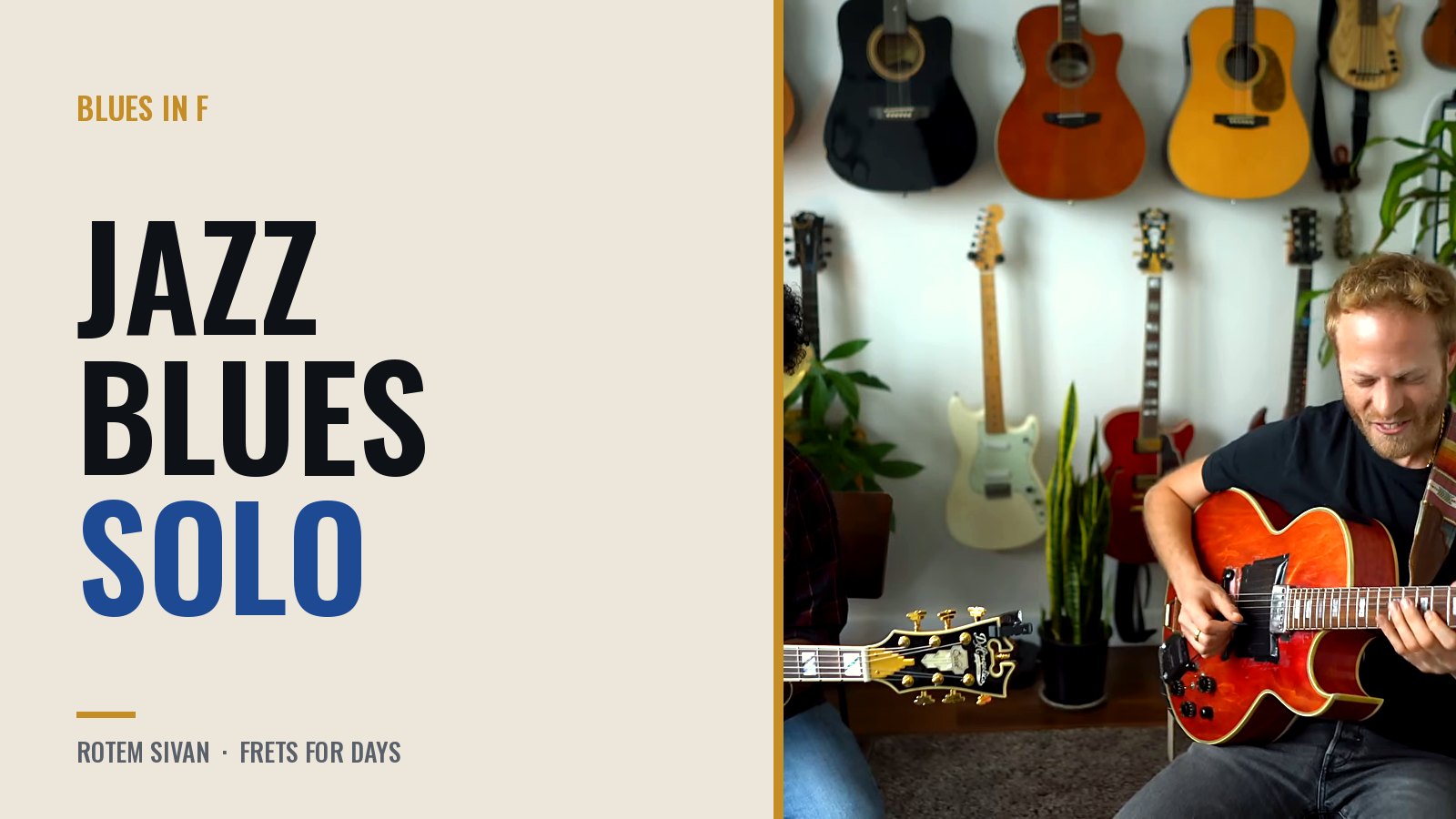
A good way to build a jazz blues guitar solo is to give each 12-bar chorus one concept and stick to it. Solo one chorus with only triads, the next with octaves, the next adding ii-Vs or a reharmonization, and another trying to play as melodically as you can. Each chorus adds a tool you can reach for later.
This lesson is a little different. We play a blues in F and trade solos with you: I play a chorus, then you play a chorus, then Gabe plays a chorus, then you again. I write the ideas on the screen, so you can see what we’re thinking and take your own turn with them.
What are the chords in a jazz blues in F?
A jazz blues keeps the 12-bar shape of the blues but adds more chords, mostly ii-Vs and passing chords that pull you from one dominant to the next. There are many versions. Here’s a common one in F, one chord or pair of chords per bar:
- Bars 1 to 4. F7, Bb7, F7, Cm7 to F7. The Cm7 to F7 is a ii-V leading into the Bb7 in bar 5.
- Bars 5 to 8. Bb7, B diminished 7, F7, D7. The diminished chord is a passing chord back to F, and the D7 sets up the next bar.
- Bars 9 to 12. Gm7, C7, F7 to D7, Gm7 to C7. That’s a ii-V back home, then a turnaround into the top of the next chorus.
Compare that with a basic 12-bar blues, which mostly sits on the I, IV and V chords. If you want that simpler version first, the 12-bar blues guitar lesson covers it. And if the ii-V movement is new to you, the ii V I guitar lesson is the place to start.
How do you use one concept per chorus?
Pick one idea before the chorus starts and build the whole chorus around it. I think of the ideas sort of like cards. You draw one, play a chorus with it, and draw the next.
Some of the cards are concepts and some are more specific. For example, I’ll think of reharm, and then I’ll think of specific chord changes. Or I’ll add ii-Vs. I’ll use octaves. Or, more loosely, I’ll say: now I’m going to play very melodically, or at least try. Of course you can decide to use other ideas and other cards. That’s totally fine.
I think it’s helpful to keep your solo concise for one chorus and use something you’ve maybe never done, or something you’re not comfortable with yet, just to get more things going. That way you practice and play at the same time.
Which solo concepts work over a jazz blues?
Any concept you can hold for 12 bars. These are the kinds of cards I mention in the video. The explanations of what each one asks for are standard jazz ideas, so you can try them even before you watch.
- Triads only. Solo using just the 1, 3 and 5 of each chord as it goes by. On F7 that’s F, A and C. On Bb7 it’s Bb, D and F.
- Octaves. Play your melody in octaves, two of the same note an octave apart. There are a lot of ways to grab an octave on the guitar, and you can also try a unison.
- Add ii-Vs. Before you land on a chord, imply its ii and V. Gm7 to C7 leads to F, and Cm7 to F7 leads to Bb.
- Reharm and specific chord changes. Think of the specific chord changes you’d put under the blues, and solo as if they’re there.
- Play melodically. A looser card: for a whole chorus, try to play very melodically.
There are a lot of sounds and a lot of ways to explore and make something ours. The idea is to get more tools in the toolbox, a larger arsenal of information we can draw from. Then, on the fly, when you’re playing with people, these ideas are accessible.
How much should you practice versus play?
Give playing real time, not just whatever’s left after the drills. I think one of the biggest mistakes people make is that they practice a lot but don’t practice playing.
We all do it. You say, I’ve got to shed this scale, and you shed it for two hours. But maybe you should have shed it for half an hour. Or two hours the first day, and then the next day an hour of practice and an hour of music. Because doing it in context is where it really gets us, every time.
Sometimes it’s helpful to concise your solo for one chorus and utilize something that maybe you’ve never done.
Rotem Sivan
Nothing in this video was prepared. I wrote a few ideas down and called them out as we went, and Gabe didn’t know what was coming. It’s not easy. That’s the point of playing with you: it pushes you a little bit, and us as well.
A practice idea for today
Put the video on and take your choruses when it’s your turn. Use the ideas we write on the screen and commit to each one for all 12 bars, even if it feels awkward. Then do one more round with a card of your own, one you’ve never tried.
If you want a way to hear, feel and create over the blues so your solos come from your ears instead of muscle memory, that’s what Simple Blues Soloing is built for. And when you’re ready for the full picture, Solo Mastery is my full framework for improvising: over 40 concepts for soloing, plus 10 real performances broken down note by note.
Frequently asked questions
What’s the difference between a jazz blues and a regular blues?
Both are 12 bars, but a jazz blues adds more chords. A basic blues mostly uses the I, IV and V dominant chords. A jazz blues adds ii-Vs, a passing diminished chord and a turnaround, so a solo has more changes to outline.
What’s a chorus in a jazz solo?
A chorus is one time through the whole form. On a blues, that’s 12 bars. When musicians trade choruses, each player solos for one full time through the form and then the next player takes over.
How do you practice soloing over a jazz blues?
Give each chorus one concept, like triads only, octaves, adding ii-Vs, a reharm or playing melodically, and stick to it. Keep the solo concise and choose ideas you’re not comfortable with yet. Then make sure you spend real time playing, not only practicing.
How long should I practice a scale before playing music with it?
Don’t spend all your time on the scale itself. Instead of shedding it for two hours every day, try two hours the first day, then an hour of practice and an hour of music the next. Using it in context is where it really gets tough.
Press play, wait for your chorus, and pick a card.



