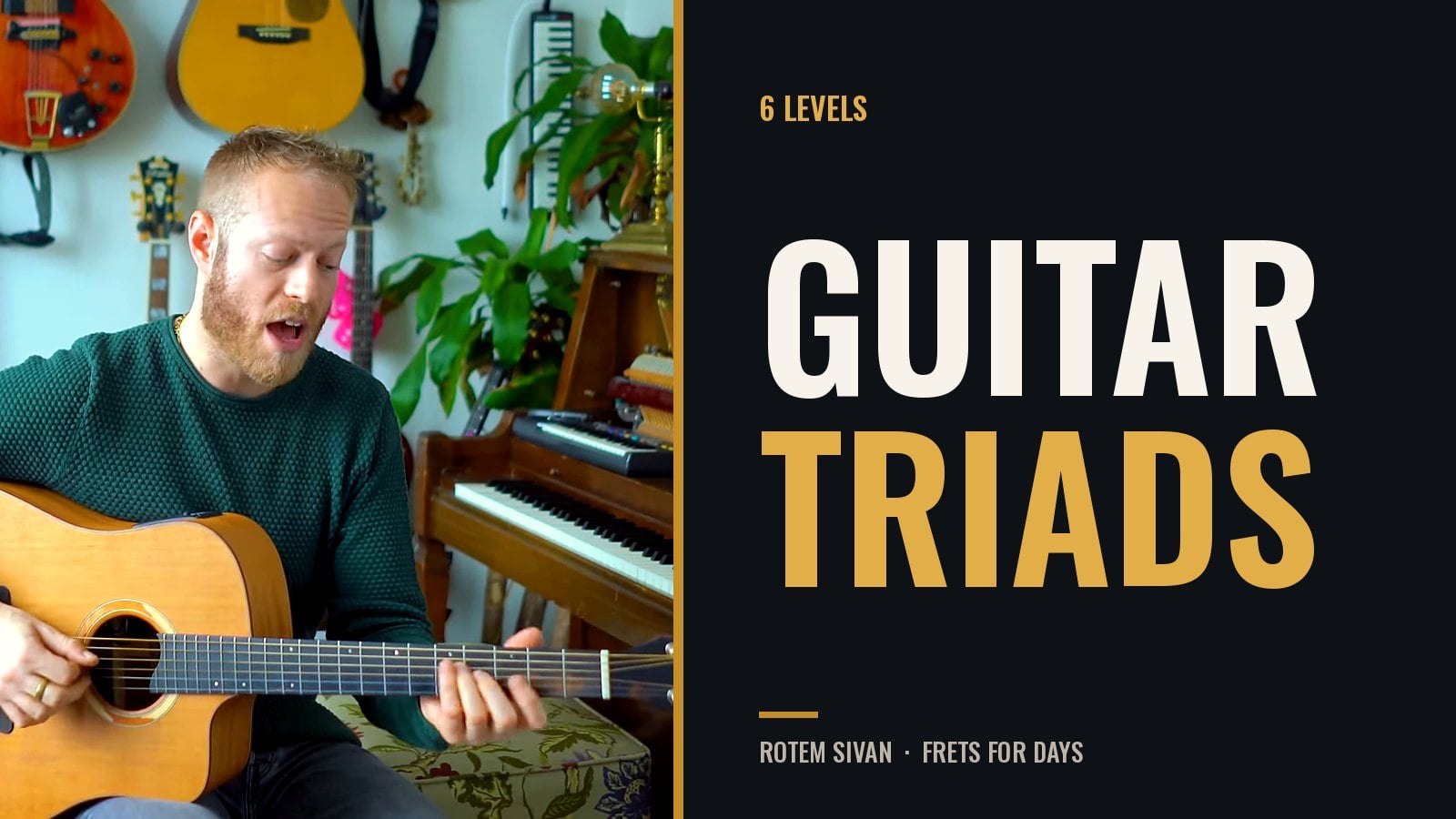
Guitar triads are three-note chords built from the 1, 3 and 5. A G major triad is G, B and D. To learn them, play those three notes in different orders, called inversions, in one area of the neck, hear each one, then spread them across the neck and break them into two-note shapes.
When I started playing guitar and heard people play these cool two- and three-note voicings, I always thought it was magical, and I had no idea what was happening. Now I have a few points of reference that make everything a little easier. This lesson walks through them in levels, using G major and then G minor.
What’s a guitar triad?
A triad is the center of a chord: the 1, 3 and 5. For G major that’s G, B and D, or sol, si, re if you think in solfège. You can hear it on the open strings, super simple.
Whether it’s a jazz song, a blues song or a pop song, we always hear little fills and little lines that connect the dots. We can definitely explore those ideas, but I feel the ground zero, the way to build and be flexible with this information, is understanding what’s underneath it. The triad is a really good place to start. Add a 7th and you’re into 7th chords, which is where shell chords come in.
Level 1: play G major in one area, in every inversion
Take the same three notes and play them in different combinations, all in one area of the guitar. An inversion is the same chord with a different note on the bottom.
- Root position. G, B, D (sol, si, re).
- First inversion. B, D, G (si, re, sol).
- Second inversion. D, G, B.
Go slowly and in time, and make sure the fingering is clear. When I’m playing this, I’m thinking about the notes and the sound I’m hearing. It’s all G major, but I’m aware that this shape is first inversion and that one is root position. I feel pretty strongly that this is the basis for all those cool embellishments.
Level 2: hear it and sing the bass
Hearing the triad is what makes it stick and what lets you use it. So instead of moving around fast and getting overwhelmed with information, listen really slowly and peacefully.
Notice how each shape makes you feel. G major has a certain vibe, a certain energy. Listen to how G major in first inversion feels too. As you play the inversions across this area, sing the bass and follow the bass motion.
When we’re working on music, we have to make this emotional finger ear connection. Otherwise it’s not gonna really stick.
Rotem Sivan
Understand it too: this is B, this is D, this is G. It might take a moment to work with it, but if you’re serious about guitar and music, it’s a really good investment.
Level 3: find G major in three areas of the neck
Once one position is clear, take G major to about three main areas of the guitar so you’re not limited to one spot.
One of my goals is to feel free to create and interact, on stage or when I’m writing. So go through each area, ascending and descending, and see how the shape breaks down into its inversions. Keep thinking about the notes, because later on you’ll want to be flexible enough to adjust them and change them when you’re creating. It’s an investment for the future.
Some positions aren’t the most comfortable, but they’re still doable. You can also take one set of three strings and run the G shape along it. Some shapes are more common than others, but there’s nothing wrong with any of them. It’s all G.
Level 4: break the triad into two notes and add an approach note
Take the same position and play just two notes of the triad at a time. Now intervals start appearing: G up to B is a major 3rd, B up to D is a minor 3rd, and D up to G is a 4th.
Those intervals still suggest G major, so you don’t always have to play the full chord. You can even play just a 4th. Especially if you have a bass player or a piano player, maybe all you need is a little thing. When we hear these sounds and understand what we’re doing, it all gets really flexible.
Then add an approach note. Play each two-note shape a half step beneath first, then land on the G major shape. It’s chromatic, like F sharp to G. You can do the same thing with the full three-note triad. All of this works because I’m not using open strings, and it’s just a really cool sound.
Level 5: do the same with G minor
G minor is really the same idea: the same three areas of the neck, with two notes or three. A G minor triad is G, B flat and D, so the only change from G major is the 3rd, lowered a half step.
As you play it, listen to the color and how it makes you feel, so you can really tag that information.
Level 6: make music with it
This is probably the most important one, and it’s one I need to remind myself of as well. As guitar players we tend to practice elements. It’s great, it sounds great and it’s fun to practice, but at the end of the day we want to make music.
So take the pieces you’re working on, even if it’s just a little thing, and make some music with them. Play a blues, or try to write a song. A really good way I’ve found is to switch between a line and these dyads or triads. Practicing these shapes, seeing them and hearing them helps you hear these ideas when you’re playing.
Here’s a practice idea for today. Pick one area of the neck and play the G major inversions slowly, in time, singing the bass. Break them into two-note shapes and approach each one from a half step below. Then improvise a short phrase that switches between a single-note line and those dyads. Try to give the improvising about as much time as you give the drilling, instead of just being in the lab.
If you want to build this step by step, Triads Workshop builds triads into your hands and ears one short video at a time, from major and minor from the 6th and 5th strings to open triads. The Inversions Course maps the chords of C major across the neck in every inversion. And if you want to turn triads into lines, the guitar arpeggios lesson is a natural next step.
Frequently asked questions
What notes are in a G major triad?
G, B and D: the 1, 3 and 5 of G major. In solfège that’s sol, si, re. You can hear all three on the open G, B and D strings before you move the shape up the neck.
What’s a triad inversion?
It’s the same three notes with a different one on the bottom. G, B, D is root position, B, D, G is first inversion, and D, G, B is second inversion. They’re all G major, but listen to how each one feels, and sing the bass as you play them.
Can two notes take the place of a full triad?
Yes. Two notes from a triad, like a major 3rd, a minor 3rd or a 4th, still suggest the chord. Especially with a bass player or piano player in the band, a little two-note shape may be all you need.
What’s the difference between a major and a minor triad?
The 3rd. G major is G, B and D, and G minor is G, B flat and D. Lowering the 3rd a half step changes the color from major to minor, while the root and 5th stay where they are.
Pick one area of the neck, get G major clear in your hands and ears, and then go make something with it.



