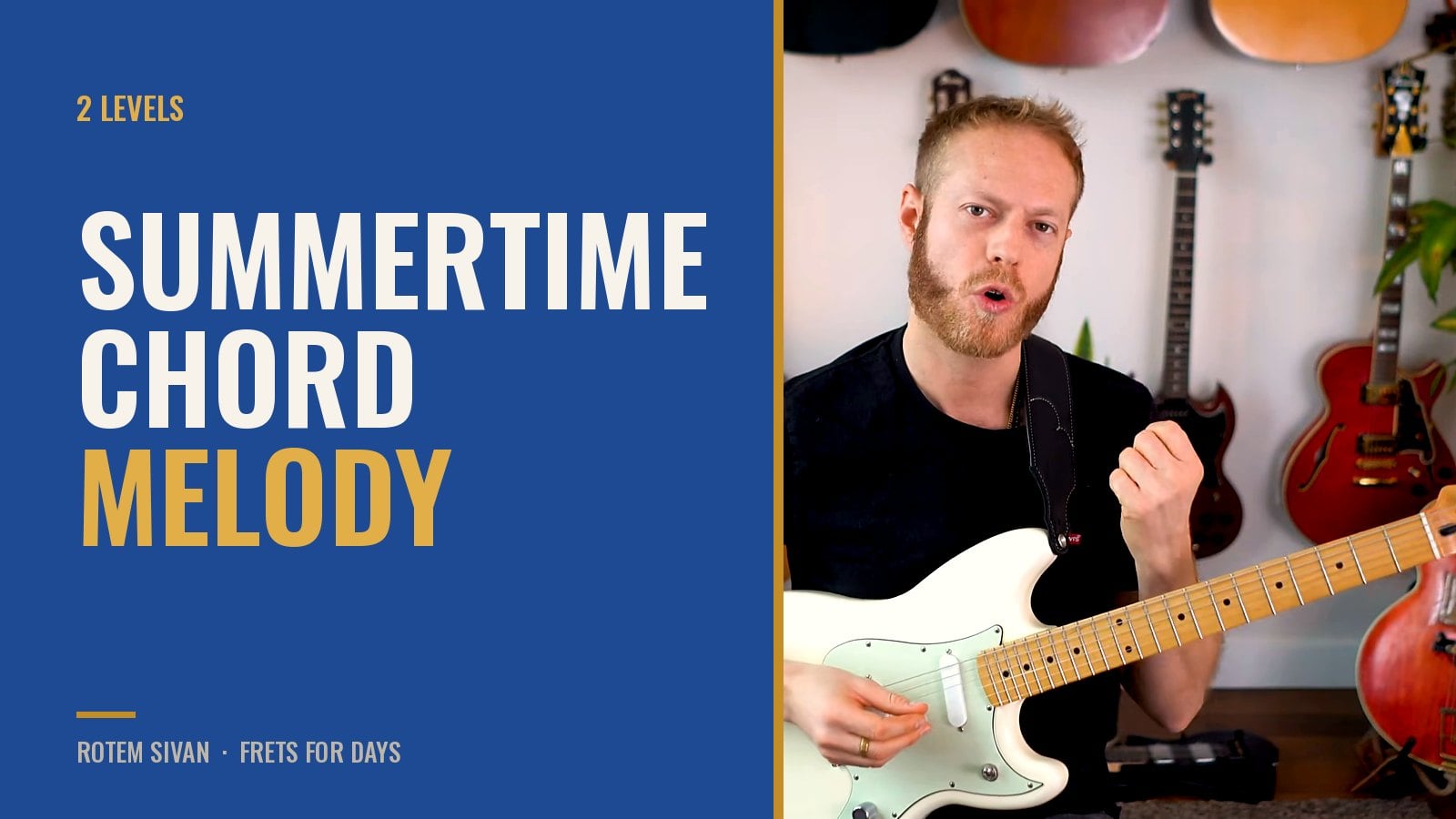
To play Summertime as a chord melody on guitar, play the melody in D minor around the second position of the D minor pentatonic, and fill the spaces between melody notes with shell chords (the 1, 3 and 7). Then grab the melody on top of fuller voicings like D minor 6 and G minor 7 with the 9.
Summertime is a beautiful jazz song that I love, and I think it holds a lot of harmonic and melodic content that’s super important to check out. This lesson does it in two levels: first the chords and melody played in a simple, super clear and strong way, then some more complex voicings so you can expand your chord vocabulary.
How do you play Summertime chord melody on guitar?
Play the melody, then fill in chords in the spaces between the melody notes. That’s the whole first level, and it’s very, very simple.
The chords I’m using are mainly shell chords. These are very simple chord shapes that hold the 1, 3 and 7, which is enough to express the chord. If you’re not sure about them, the shell chords lesson covers how they’re built. In the video you’ll hear a quick D7, D minor and G minor, then a move to B flat and A, with G minor 7 as a shell again.
Super simple, but again, it’s so beautiful because the melody is great and the chords are great, so the relationship makes the magic happen.
Rotem Sivan
Where’s the Summertime melody on the guitar neck?
In this version it lives in D minor, inside the D minor pentatonic. I’m playing it mainly in one area of the neck, so I can see a lot of the melody in the notes across that fingering and location.
D minor pentatonic is D, F, G, A and C. If you can see your pentatonic in the second position, that’s very helpful. If that box still feels unfamiliar, spend some time with the pentatonic scale first and come back.
How do you learn the Summertime melody by ear?
Know the melody and the chords separately before you put them together. If you really know the melody and really know the chords, chord melody gets much, much easier.
Really knowing the melody means more than playing it and seeing where it is. You want to hear it. So in the video I move it to A minor, just because it’s a different key and I want to make sure I can hear it there too. In A minor you can start with the note E and figure it out from there. If it’s hard, that’s fine. Take your time and dive into the melody.
- Start in D minor. Play the melody alone in the position you just learned.
- Move it. Try it in a few different areas, then in other keys, like A minor starting on E.
- Connect it to the key. Make sure you see it, you hear it, and you understand the relationship between the notes and the key center.
- Know the lyrics. You don’t have to, but it’s a very songy song. You can really imagine the atmosphere and mood, and I think the lyrics are very helpful here.
Level 2: grab the melody inside the chord
In the second level the melody note sits on top of the chord, so you play them at the same time instead of taking turns. It’s the same idea of chords and melody, but now I need to find different voicings to make it happen.
Here’s what happens through the first A section:
- D minor 6 with the melody on top. The melody note A is on top. You can also add the open E to get D minor 6/9, which is super lush.
- A diminished sound. The same shape a whole step away, to get that melody.
- D minor in first inversion. For the next part of the melody, with the A held by the first finger.
- D over A, then D7 over A. Then an F sharp diminished, which I’m really hearing as D7 flat 9 in first inversion. It’s just a little sound.
- Perfect fourths. A shape built all in fourths. It’s pretty wrong, but it still sounds good, just a splash of color. After a diminished chord low on the guitar, that sound is so different that the contrast feels great.
- G minor 7 with the 9. Then the bass descends from there.
- A7 flat 9 with E in the bass. I went up to get a little more tension, and then the resolution.
The song is in AABA form, so the second A starts with the same melody. This time I go to G minor and C7: a G minor shell with the 9 added for color, G minor in first inversion, and a little hammer-on on a C7 with the 13 and flat 13. Then F major, because I just wanted a different sound, played as a 10th: a super guitar, triadic sound. From there it’s B flat with the 13, through B flat 7, to A7 flat 13, which leads to D minor.
Near the end there’s a voicing that’s basically a fourth with A and D, with the open E. That’s very McCoy Tyner, very piano. Pat Metheny uses that sound too in a few of his songs.
How do you choose voicings for a chord melody?
Stay aware of the melody, the chords and the form, then use repetition while changing little things. I’m not trying to showcase anything. I just want to show you some options for grabbing the melody: sometimes with a triad, sometimes with chromatic ideas, sometimes with perfect fourths.
- Add color where the harmony allows it. If I know it’s G minor 7 to C7, maybe I’ll add the 9, maybe a little tension.
- Think about register and sound. If I just had a diminished chord, I might use fourths next.
- Use contrast. If I used a lot of chromatic chords, maybe now I’ll go really simple, with single notes. That transition and contrast creates a lot of interest.
All of this sits on knowing your shapes. If shells and inversions still feel shaky, Jazz Chord Essentials rebuilds your chords from the ground up: how a 7th chord is built, the four main colors (major 7, dominant 7, minor 7, half diminished) and every inversion on the 4th, 5th and 6th string sets. For another standard worked out the same way, try the Stella by Starlight chord melody.
A practice idea for today
Play the Summertime melody alone in D minor, around the second position of the pentatonic. Then play it in A minor, starting on E, until you can hear it in both keys. Go back to D minor and fill only the gaps with shell chords. When that’s easy, take the first phrase and try putting the melody note on top of a D minor 6 shape, adding the open E for the 6/9.
Frequently asked questions
What key is this Summertime chord melody in?
D minor, using the D minor pentatonic in the second position as the framework for the melody. To make sure you really hear the tune, also try the melody in A minor, starting on the note E, and then in a few other keys.
What chords do you use for an easy Summertime chord melody?
Shell chords: simple shapes that hold the 1, 3 and 7. In the first version you play the melody and fill those shells into the spaces between melody notes, with chords like D minor, G minor 7 and a quick D7.
How do you keep a chord melody from sounding repetitive?
Use repetition, but change little things. When the second A starts with the same melody, I might add the 9 to G minor 7 or a little tension on C7, and I think about register and contrast, like going simple after a lot of chromatic chords.
Is chord melody hard on guitar?
It can sound scary and it’s not easy, but the more you do, the easier it gets. I’ve spent a lot of time practicing chords and working on different songs, so a new song is easier now. It’s a process.
If you want to get good at running, you’ve got to run. Pick the first phrase of Summertime and go make some music.



