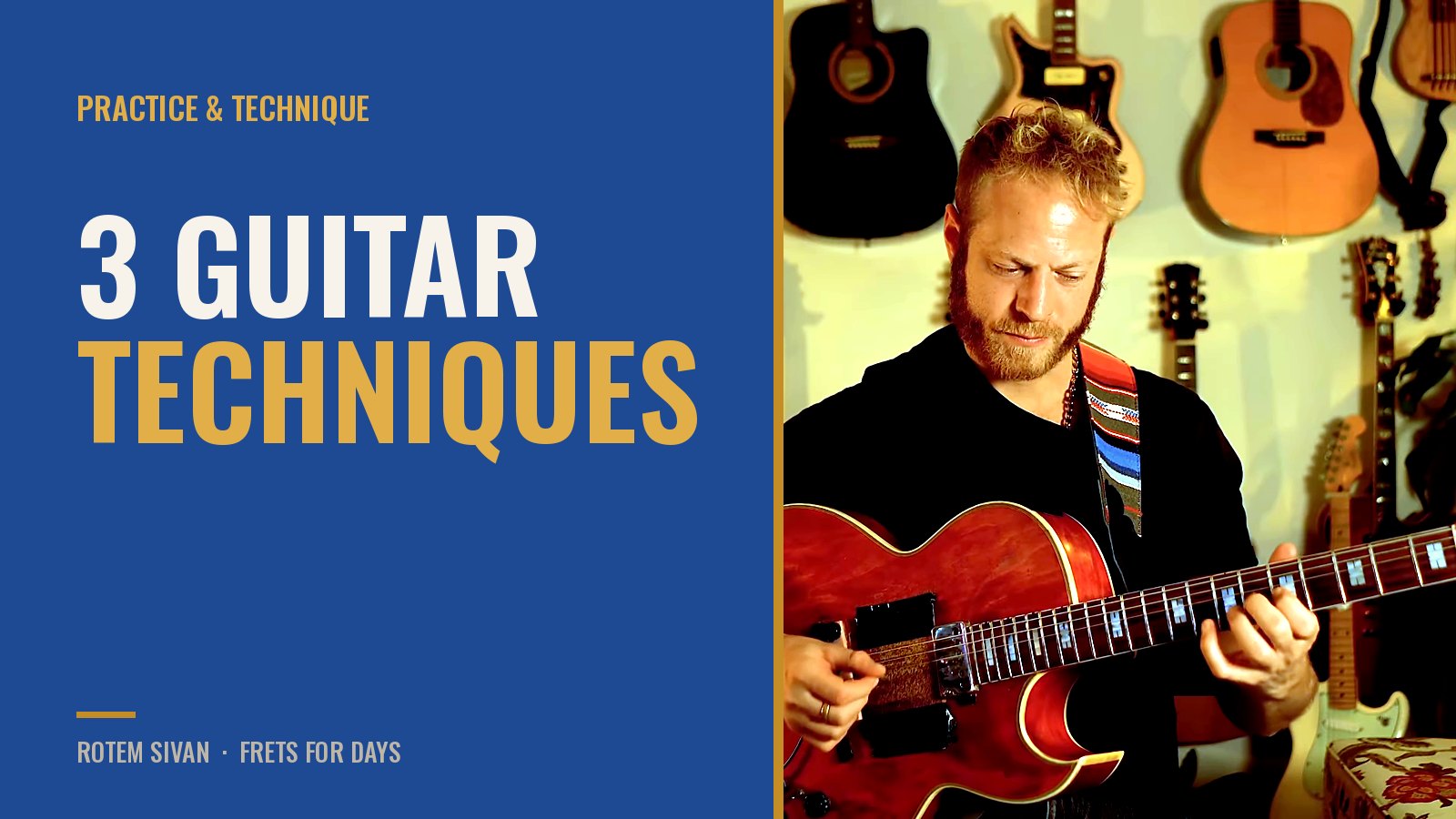
The three guitar techniques I’d focus on are alternate picking (down, up, down, up), legato (pick one note and hammer on or pull off the rest), and a mix of the two, where you pick two notes and hammer on the third. Each one is important on its own and has its own sound, and for me the combination really does the trick.
I remember very clearly hearing crazy guitar players when I started and thinking, how can I ever play that? I thought if I played something a lot, it would get better. That’s not untrue, but it’s not the full truth either. This lesson gives you a few exercises for each technique, the way I practice them.
What are the most important guitar techniques?
For me it’s alternate picking, legato and a hybrid of the two. Each one is important on its own and meaningful in a different way, and putting them together is what really does it.
- Alternate picking. Literally down, up, or up, down. It has a very articulated sound.
- Legato. Pick the first note and hammer on the others (or pull off on the way down). It has more of an almost horn-like sound.
- The mix. Alternate pick two notes and hammer on the third. It gets you the goodness of both worlds.
Technique 1: how do you practice alternate picking?
Slowly, with a metronome, on one note first, and with your attention on the wrist. Then on a short chromatic shape, so the two hands learn to move together.
- One note, subdivided. Every morning I put the metronome on 40 BPM and try to feel that pulse. I take one note and subdivide the beat. Usually I go from 1 to 12 notes per beat. In the video we do 1 to 8.
- A four-note chromatic shape. This is something else I do every morning. I stay around 40, sometimes a little faster, and play a four-note chromatic shape with alternate picking. Here I push the subdivision further, to 8, 12 and sometimes 16 notes per beat.
On the first exercise, I try to be hyper aware that I’m using more wrist motion than fingers. That’s me, and it’s how I’m building my technique. When I play really high tempos, or higher subdivisions like 9, 10, 11 and 12, I start using some of the arm and the elbow. But the idea is to let the motion sink in and make sure it’s clear. It’s a really simple exercise, and it’s super useful.
On the chromatic shape, the goal is syncing the right and left hand. At the higher subdivisions I’m not 100 percent accurate. I’m trying to be, of course, but the point is to sync the two hands as much as I can while keeping the alternate picking and the wrist motion.
Technique 2: how do you practice legato?
Take a three-notes-per-string scale, pick the first note on each string and hammer on the other two, and go extremely slow until your fingers know where everything is. Then play it in time, then start it from every note of the scale.
Legato is a huge one on guitar. Alternate picking sounds great and I definitely like it, but legato is just a very different sound from picking each note separately. It’s a different articulation, a different color, and a really cool guitar sound.
- G major, three notes per string, out of time. Pick the first note and hammer on the next two, extremely slow. Slide the last finger, like I do in the video. You’re just marking the placement, teaching your fingers where things are. Watch the balance and dynamics too. I don’t want one note crazy loud and another crazy soft. I want them somewhat balanced.
- A hair faster. Same thing, a little quicker. I’m playing all downstrokes with my right hand here.
- In time. Now put it in time.
- From every note of G major. Play legato three notes per string starting from each note of the scale. First map out the notes, as if you’re telling your fingers and brain what’s going to happen, and repeat it quite a few times until it’s clear as a mental image and as a sound in your ears. Then start from the next note, A. I’m still thinking G major, but I’m aware it’s the Dorian mode, and I can still sing G.
We didn’t do pull-offs in the video, but it’s the same thing when you descend. The point is tagging the information: playing it slow, teaching your fingers where things are, keeping everything balanced.
Technique 3: the mix of picking and legato
On each string of a three-notes-per-string scale, alternate pick the first two notes and hammer on the third. It’s a combination of alternate picking and legato, and it gets you the goodness of both.
I found this through a really great guitar player from Australia. There’s a whole family of wild Australian guitar players who use this technique. It’s new for me as well. When I made this video I’d been doing it for just a couple of weeks, and it was already kind of magical. I guess I used it to some extent before without really understanding that I was doing it, and now I’m trying to shift toward it consciously.
- One position, really slow. Play the G major scale three notes per string with this technique, ascending and descending. I do it every morning in different scales and different keys. G is great, F is great, whatever you’re feeling. Use a click, and try eighth notes, triplets and 16ths at different tempos. Keep it slow until your fingers understand what’s going on.
- The whole fretboard from different notes. Ascend and descend G major starting from different notes, sliding to move up the neck, so you cover the whole fretboard. You can call them the different modes of G major, but I think of it as one big G with different fingerings.
The more you do it, the more comfortable it gets. It sounds really great going up and coming down, and it feels great.
Taking it slow, taking it day by day, and working on all these techniques little by little is really, really helpful and useful.
Rotem Sivan
A practice idea for today
Set the metronome to 40 BPM. Pick one note with strict alternate picking, moving through 1, 2, 3 and up to 8 notes per beat, and keep the motion in the wrist. Then take G major three notes per string and play it two ways: once legato (pick one, hammer two), once with the mix (pick two, hammer one). Go slow enough that every note is even in volume. For me, understanding that you can play things fast or slow and with different articulations made a big difference.
If you want the routine I play first thing every morning, Technique & Speed is adapted from what my classical guitar teacher showed me, in notation and tab, starting with open-string picking. 5 Steps to Freedom is a short video course on the mechanics underneath everything you play: five motions in three to five minutes a day. When you’re ready to bring the speed up, the tricks for playing fast on guitar pick up where this leaves off, and the guitar practice routine shows where technique fits in a full session.
Frequently asked questions
What tempo should I use for alternate picking practice?
I start at 40 BPM and subdivide one note from 1 up to 12 notes per beat. I keep my attention on the wrist so the motion is clear. On a four-note chromatic shape I sometimes go a little faster and push the subdivision to 16.
Should alternate picking come from the wrist or the fingers?
I try to use more wrist motion than fingers. That’s how I’m building my own technique. At really high tempos or subdivisions like 9 to 12 notes per beat, I start using some arm and elbow as well.
What’s the difference between alternate picking and legato?
Alternate picking plays every note with the pick, down and up, and has a very articulated sound. Legato picks one note and hammers on or pulls off the rest, which has more of an almost horn-like sound. They’re different articulations, and a hybrid of the two exists too.
How do you practice legato without uneven notes?
Go extremely slow, out of time at first, and listen to the balance between the notes. You don’t want one crazy loud and the next crazy soft. Once the placement is clear, play it a hair faster, then in time.
Pick one exercise from each technique, give it a few slow minutes tomorrow morning, and keep coming back to it day by day.



