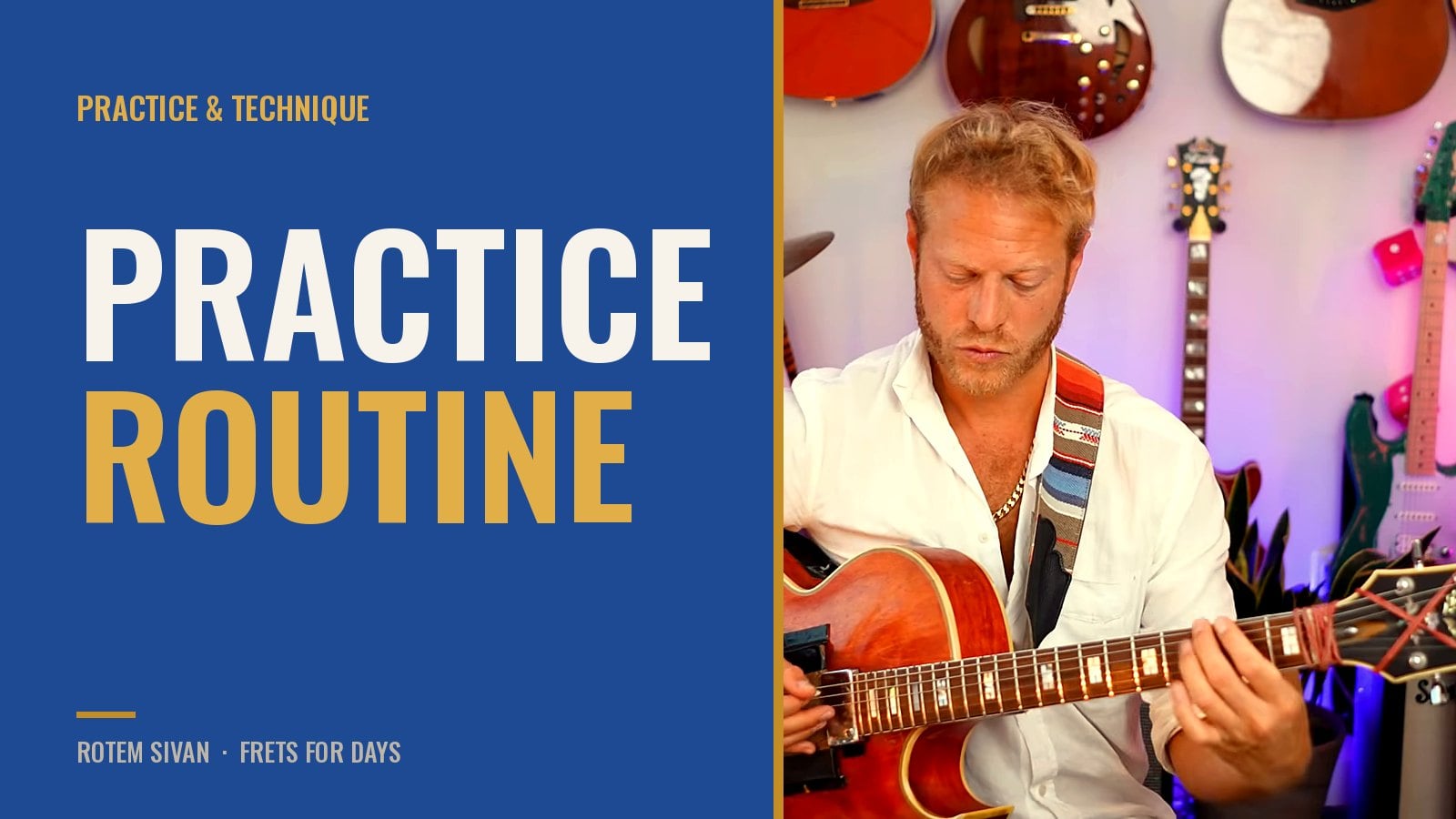
A good guitar practice routine starts with what you want to play, then feeds it with a few basics: knowing the notes on the fretboard, a slow drill for the picking hand, scales played on single strings and in different rhythms, and time spent making music with whatever you’re working on. When progress stalls, change the material.
When I started practicing guitar seriously, I put in a lot of hours, but I didn’t really know how to do it well. This post walks through the routine and warm-ups from the video below, so you can save yourself some of that time.
Start by asking what you want from music
Before you pick exercises, ask yourself what you want from guitar, and what you actually need to practice to create the music you love.
It’s easy to practice things because they seem good for you: more scales, modes, whatever it is. I’m not saying that’s wrong. It’s good stuff. But the real question is what you need for your craft. If you want to play BB King blues, you probably need to know your pentatonic really well, and you probably need to transcribe some things.
Then look the beast in the eye: assess your playing as honestly as you can, including what’s missing. Say you’re working on the G major scale, and to be honest, you don’t know the notes and you can’t sing it well. Those are crucial elements, and if you practice them, I promise you’ll be able to do them very soon. If you can say “I don’t even know what a major 7 is,” great. Now you can explore it. If you tell yourself you kind of know it when you don’t, it’s really hard to progress.
Then bring things to excellence as much as you can. Don’t cut corners. If you’re learning a scale, really listen and connect with how it feels. I know it takes time, but that’s real progress.
How do you learn the notes on the fretboard?
Take one note and find it everywhere it lives on the neck. Start with C, find all its octaves, then do the same with D, and keep going. The notes repeat, and once you see the repetition, the shapes you already play start to make sense.
When I started playing guitar, I played all these shapes without understanding what was happening inside them. Then I realized that if I know the notes on the fretboard, I can see the information repeating. It’s a game of tagging.
It helps with chords, too. An E can be part of C major, but that same E also lives in G13 and A minor 7. If you understand one note and how it functions against different chords, you learn music much faster. If you want to go further with this, my post on how to learn the guitar fretboard walks through it step by step.
How do you stop missing strings when you pick?
Practice the picking hand on its own, very slowly, in two motions: prepare the pick on the string, then release. Do it without looking, so your fingers learn exactly where each string is.
When I started playing, I was always afraid of hitting a string I didn’t mean to, and sometimes I did. So for a while I practiced the right hand separately from the left. Take an open string, or a barre chord shape, and put the pick on the string, release, prepare, release. Very slow, without looking at the strings. I close my eyes. The idea is to teach your fingers, at a micro level, exactly where the strings are, so you find them automatically when you’re not thinking.
There are four permutations to run through:
- All down. Every stroke is a downstroke.
- All up. Every stroke is an upstroke.
- Down up. Alternate, starting with a downstroke.
- Up down. Alternate, starting with an upstroke.
Later on, play them a little faster and try some variations. Sometimes people don’t pay attention to the picking hand at all, but I think it’s important. This drill helped me, and still helps me, feel comfortable on the different string sets. Open-string picking is also where Technique & Speed starts. It’s the routine I still play first thing every morning, adapted from what my classical guitar teacher showed me, written out as a PDF in notation and tab.
How should you practice scales?
Think of a scale as a color, not just a shape. Learn one position until you know its notes and sounds, sing it, play it on one string at a time, then lock it into quarter notes, eighth notes, triplets and 16th notes.
Take G major in one position and really understand what the notes and the sounds are. Sometimes I sing it. You don’t need to be an opera singer. You just want to sing it and connect with it as much as possible on an emotional level. If you want a whole method built on singing what you play, my post on how to play guitar by ear goes there.
Then look at the scale from different angles. I still do this. Can you play G major on one string? Think the notes, G A B C D E F# G, and find them. Then do the same on each string. Knowing the notes from the octave work makes this much easier. It’s okay to make mistakes, as long as you’re trying to learn the information truthfully.
After that, bring in time:
- One rhythm at a time. Stay in one position and play the scale in just quarter notes until you feel comfortable, then just eighth notes, then just triplets, then just 16th notes.
- Mix them. Do this in each area of the neck, then mix the rhythms and move all across it.
Eventually you see the scale as one unit, a sound you’re accessing. Locking into those rhythms is tremendously important, and it’ll change how you hear things and how you respond to music.
What should you do when practice hits a plateau?
Let it go and practice something else. When progress on one thing slows down, switch to new material, and come back to it later, maybe in a week, a month or six months.
This was a big realization for me. I’d practice something and feel I was getting better, and then after a week or two, sometimes longer, I’d hit a plateau. I kept practicing it because I hoped I’d keep getting better, and it didn’t really happen. Later I realized I didn’t need to practice that thing again and again. I needed to let it go.
Music for me is this beautiful ball of light that I’m looking at from different angles.
Rotem Sivan
Whether I’m playing piano, singing, playing guitar, doing exercises or writing music, I’m trying to learn and highlight different parts of that same thing. If I just nail one thing all the time, I won’t see the whole circle. So stay flexible, and change your routine when you feel the plateau. If you’d like more work on the mechanics underneath all of this, 5 Steps to Freedom is a short video course: five motions in three to five minutes a day, including a “mini gym” for the fretting hand.
Turn every exercise into music
This might be the most important part. Playing the shape isn’t good enough. Whatever you’re working on, take it straight into making music, even if it’s only a few notes on one string.
There’s the framework, the shape or scale you’re working on, and then you need to take it to the music. So if I’m working on the G major scale, I’ll take one string from that shape, almost nothing, and try to create something with it right away. That way it doesn’t stay in the box of “okay, I practiced my practice.” It becomes “let’s make music today.”
Try this routine today:
- Picking hand. Prepare and release on the open strings, slowly, through all four permutations, without looking.
- One note. Pick a note, like C, and find every octave of it on the neck.
- One scale. Sing G major in one position, play it on one string, then run it in each rhythm.
- Make music. Take one string of that G major shape and play something you’d want to hear.
Frequently asked questions
What should I practice first on guitar?
Start with what you want from music. Ask what you need to create the music you love, then honestly assess what you can’t do yet. That tells you what belongs in your routine. For BB King blues, for example, you probably need to know your pentatonic really well and transcribe some things.
How do I stop hitting the wrong string when I pick?
Practice the picking hand separately from the fretting hand. Prepare the pick on the string, then release, very slowly and without looking, so your fingers learn where the strings are. Run it all down, all up, down up and up down, then a little faster.
Should I keep practicing an exercise until I master it?
Not if you’ve hit a plateau. When progress on something slows down, let it go and practice something else, then come back to it in a week, a month or six months. Changing the material keeps you seeing music from different angles.
Pick one item from that routine, play it today, and before you put the guitar down, make a little music with it.



