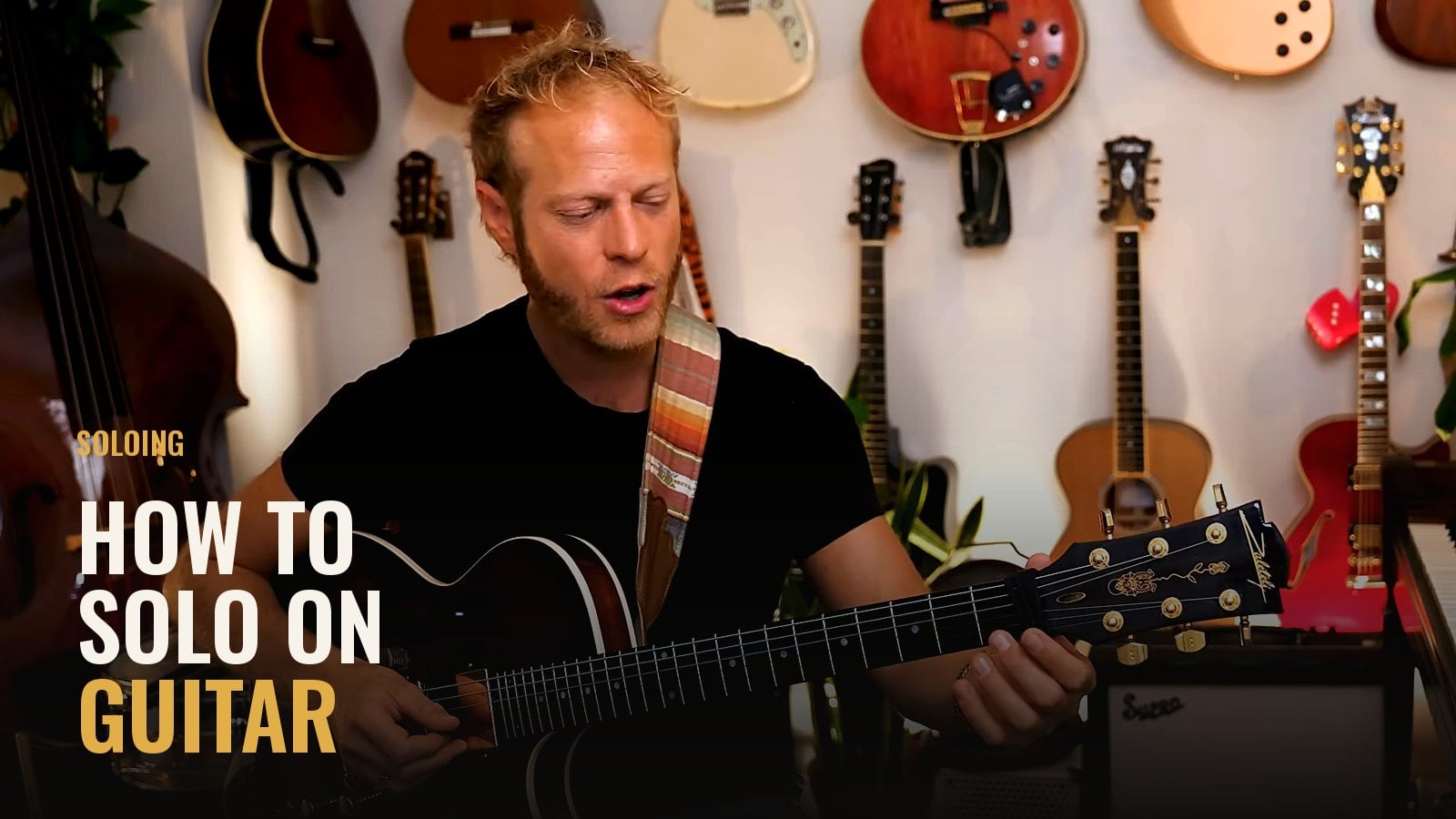
To solo on guitar, start with one scale and give yourself a restriction: one string, one interval, one position or one rhythm. In this lesson I use the C major scale. Inside that limit, treat each note as a color you feel, not a random point on the neck, and keep turning the exercise into music.
When I started playing guitar, all I really wanted was to solo and create things, but I was extremely frustrated. I didn’t know what to do or how to go about it. I didn’t see it, and I didn’t get it at all. This post and the video walk through those ideas step by step, using a single scale.
What’s the first step to soloing on guitar?
Give yourself a restriction. For example, solo on only one string. It’s simple.
It’s just the C major scale, but now I’m not thinking only in positions. I’m really trying to be aware of the colors, to emotionally connect, and to be aware of what I’m doing. The notes aren’t random points on the guitar. They’re colors. Play the A and let it sink in. The color of that A is kind of magical.
It doesn’t need to be crazy. It’s just one restriction, and the goal is to make music with the elements.
How do you solo with one interval or one position?
Take one sound and create only with it. In the video I use sixths. Then try limiting where on the neck you play.
- Play the interval harmonically. Play the sixth as two notes at once, a dyad, or what some people call a double stop.
- Play it melodically. Break the same interval into single notes and play it as a line. Now you can think about lines versus dyads as a concept.
- Stay in one position. Choose one area of the neck, any one, and solo only there.
- Slide between positions on purpose. Consciously move from one position into the next, so the whole guitar becomes one gigantic C major scale. Start as an exercise, just shifting through the scale, then decide to make music with it.
Try to always push a little to get out of your comfort zone and expand the toolbox you’re using.
How does rhythm make a solo sound like music?
Stay in one subdivision. Be clear about it, and start with eighth notes.
Take one position and play the scale one time so it’s clear. On its own, a scale sounds like an exercise, which isn’t bad, but it’s not music yet. So feel the eighth notes as the grid underneath what you play. You don’t have to play only eighth notes, but that’s the grid. It’s still a restriction, something to limit us, and we’re still trying to create in a musical way.
Subdivisions and double stops also show up in Simple Tasteful Soloing, which takes one line in A minor pentatonic, breaks it into its building blocks (bends, blue notes, subdivisions, double stops and singing), then gives you a simple five-element way to turn it into a solo.
How do you target notes in a guitar solo?
Pick one note, one color, and aim your lines at it. In C major, I’ll take the D, the 9, play lines that highlight it, and end there.
The idea is having that sound playfully going there. Then switch targets, maybe to the A. Seeing the scale and understanding what you’re playing is really helpful here.
Another thing I like doing is literally closing my eyes. Sometimes it’s helpful to eliminate some of the sensory information coming in, because then you’re forced to listen. You don’t have to do it if you don’t feel comfortable, but anything that expands our listening is great. If you want to go further with that, the play guitar by ear lesson is all about playing what you hear.
How do you keep getting better at soloing?
Go step by step, building block by building block, and be honest about what you can hear. We’re not trying to take over the universe.
Say, “I want to see C major scale on one string,” and practice that for one week. Simple things, but they’re super honest, and I think honesty is really important when we’re trying to learn music.
Can we hear it? Do we understand what’s happening? And then once these answers are yes, then we can create way more and push ourselves to the next step.
Rotem Sivan
And then just take the guitar and try some stuff. Maybe it’s C major, and maybe you expand to some more colors, like a G sharp, or a flat 9. That’s intense. It’s like throwing spicy hot sauce on it. I’m still in this process of learning too, always trying to learn and to emotionally connect with the sound. We learn from these processes.
A soloing practice idea for today
Take a loop with a few chords in C major. Solo over it on one string only, keep to eighth notes, and aim your lines at the D. When that feels honest, meaning you can hear it and you understand what’s happening, move the target to the A, or open it up to one full position. If you’d also like some licks to work into your solos, grab the free 5 Licks Cheat Sheet, a PDF of five licks that work over any blues or rock track.
And when you’re ready for the full picture, Solo Mastery is my full framework for improvising, with over 40 concepts for soloing, 10 real performances broken down note by note, plus shell chords, harmony, ear training and rhythm work.
Frequently asked questions
What scale should I use to start soloing on guitar?
In this lesson I use the C major scale, starting on one string. Give that one scale restrictions like one string, one position or one subdivision, and listen to each note as a color instead of a point on the neck.
How long should I practice one soloing idea?
Take it step by step. For example, decide you want to see the C major scale on one string and practice that for one week. Move on when you can hear it and you understand what’s happening, then push yourself to the next step.
What’s a double stop on guitar?
A double stop is two notes played at the same time, also called a dyad. In the video I play sixths this way, then break the same interval into single notes, so I can think about lines versus dyads as a concept.
Should I close my eyes when I solo?
You don’t have to, but it can help. Closing your eyes removes some of the sensory information coming in, so you’re forced to listen. If it doesn’t feel comfortable, skip it, but anything that expands your listening is worth trying.
So take a loop, take a few chords, take your time, and create.



