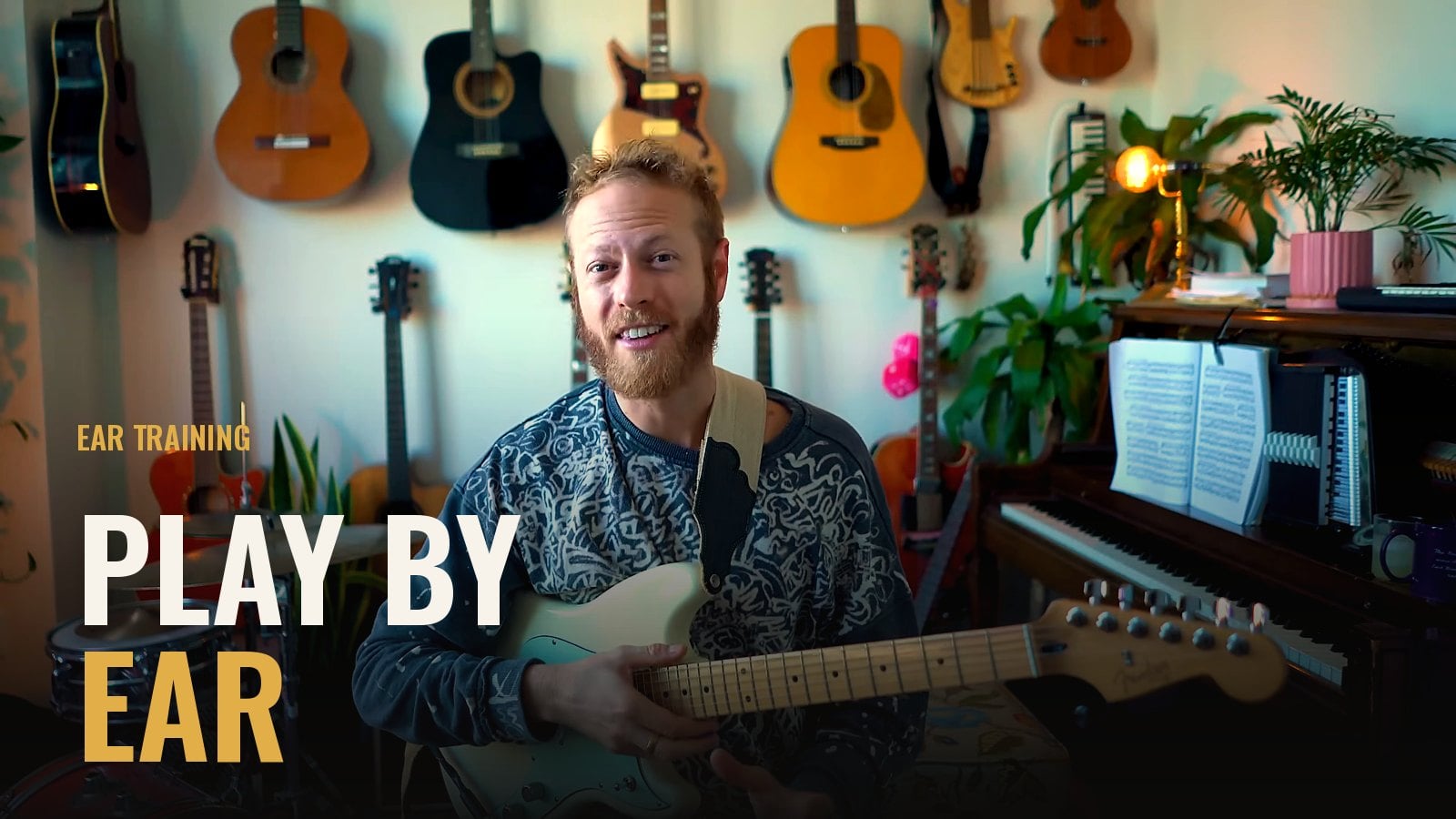
To play guitar by ear, you build the connection between what you hear in your head and where it lives on the neck. Start in one key, like C major, and know it deeply. Then play short lines and sing them back, sing lines and find them on the guitar, and give the process real time.
I feel there’s always some gap between what we imagine, what we hear internally, and what we can play. This lesson is about bridging that gap, so you can imagine something and bring it into the world in a musical way, a bit like saying an idea in a language. I break it into five levels in the video below. I practice a lot of these things every day, and it’s a process.
Level 1: Know the framework deeply
Before you can play what you hear, you need to understand the center you’re in and know the fingerings. I use C major for simplicity, but knowing it means really knowing it: feeling every note and how it relates to the center.
When I say knowing, I mean it in a very biblical way. Diving into it in a very serious and intimate way. In C major, we really feel that third, the E that gives the scale its major sound. We feel every note, and we understand the relationship between each one and the center.
Then sing it. I know I’ve talked about ideas like this before, but I can’t stress enough how important it is. If you want to play by ear, play what you hear, you want these elements intact. So I really suggest playing the framework daily, so you get really familiar with it. My post on how to learn the guitar fretboard is a good companion to this level.
Level 2: Get creative inside the framework
Stay over a drone with no set time, play a simple line of just two or three notes, and listen very deeply. Know what each note is and how it relates to the center.
Even with a tiny line, I want to know what I’m playing, by its solfege name and its note name, and I want to be aware of its relationship to the center. In C, for example, G is sol, the fifth. The idea is to tag each sound from every angle.
Then I’ll sing a different phrase, still in the framework of C major, really trying to hear the center super clearly, and I’ll check myself. You can take any melody. It doesn’t matter if it’s Happy Birthday or Over the Rainbow or just random melodies in C. The point is that you get creative and you listen very, very intentionally to the sounds. Start with C, and later on, add some chromatic notes.
Level 3: Sing a line, then find it on the guitar
Sing a line in the framework without the guitar, then try to find it on the guitar. It starts in C major, and later it can go more chromatic, or anywhere you want.
This is where it gets really cool. I do this with jazz songs, too, and it’s really fun. It tests your ear and develops your inner ear: what am I hearing, and where is it on the instrument? You’re bridging the connection between your ear and your fingers.
I think music is the art of listening, so this time is worth putting in. I practice ear training every day. It’s a big part of what I try to be aware of. Even when I’m playing scales, I try to hear them, and I try to be aware of the tension and release, because that’s the beautiful thing about music.
Keep the lines simple. You can make them more complex if you feel the urge, but take it slow. You’ll find discrepancies, and you’ll make mistakes, but we learn in that process.
These exercises are super, super important because we are basically building this muscle that connects the ears, the fingers, and the imagination.
Rotem Sivan
Level 4: Play a line and sing it back
Over a drone, play a short phrase on the guitar, then sing it back as accurately as you can. This direction is a little easier than Level 3, and you hear each phrase twice, which helps tag its colors.
For the drone, you can go to YouTube and pull up a cello drone, or just loop something. Any of these work. In the video I start adding some chromatic notes here, but you don’t have to. You can stay in the framework of C.
Play a phrase, sing it, and make sure you’re singing as accurately as possible. Then adjust it a little and go again. These are simple exercises, but they really help build that connection.
Here’s a short session you can try today, using Levels 2 through 4:
- Set up a drone. Pull up a cello drone on YouTube, or loop something, and stay in C major.
- Play two or three notes. Listen deeply and name each one, and notice how it relates to C.
- Sing them back. Match the guitar as accurately as you can, then adjust.
- Flip it. Sing a short phrase of your own first, then find it on the guitar.
Level 5: Take your time
This is probably the most important level. Learning to play what you hear takes time. It doesn’t happen in a day, and not even in a couple of weeks. It’s a process.
If you’re here, I believe you like music, and it’s probably something you care about a lot. And if you actually like music, if you actually like guitar, it doesn’t really matter whether you play this well next week, in a month or in a year. What matters is internalizing these ideas and connecting to the truthfulness of music.
I’m not here to tell you this is all easy. I’m here to help you find a path to what you want to hear and be able to do. My post on building a guitar practice routine shows where singing fits alongside scales and picking. And if you want ear training as part of a full approach to improvising, Solo Mastery is my full framework: over 40 concepts for soloing, 10 real performances broken down note by note, plus shell chords, harmony, ear training and rhythm work.
Frequently asked questions
What key should I start ear training in on guitar?
C major is a simple place to start. Get to know it deeply: the center, the fingerings, how every note relates to C, and how it sounds when you sing it. Once that feels familiar, add chromatic notes and branch out to other places.
Do I need to sing to play guitar by ear?
Singing runs through the first four levels of this method. You sing the framework, sing phrases within it, sing a line and then find it on the guitar, and play a line and sing it back. It builds the connection between your ears, your fingers and your imagination.
How long does it take to learn to play by ear?
It’s a process. It doesn’t happen in a day, and not even in a couple of weeks. If you love music and guitar, it doesn’t really matter whether you play well next week, in a month or in a year. Keep practicing the connection between your ears and fingers.
What can I use as a drone for ear training?
You can pull up a cello drone on YouTube, or loop something yourself. Either works. Play over it with no set tempo, listen deeply to each note against the center, and sing your phrases back as accurately as you can.
Put on a drone, play two notes, and sing them back. Then do it again tomorrow.



