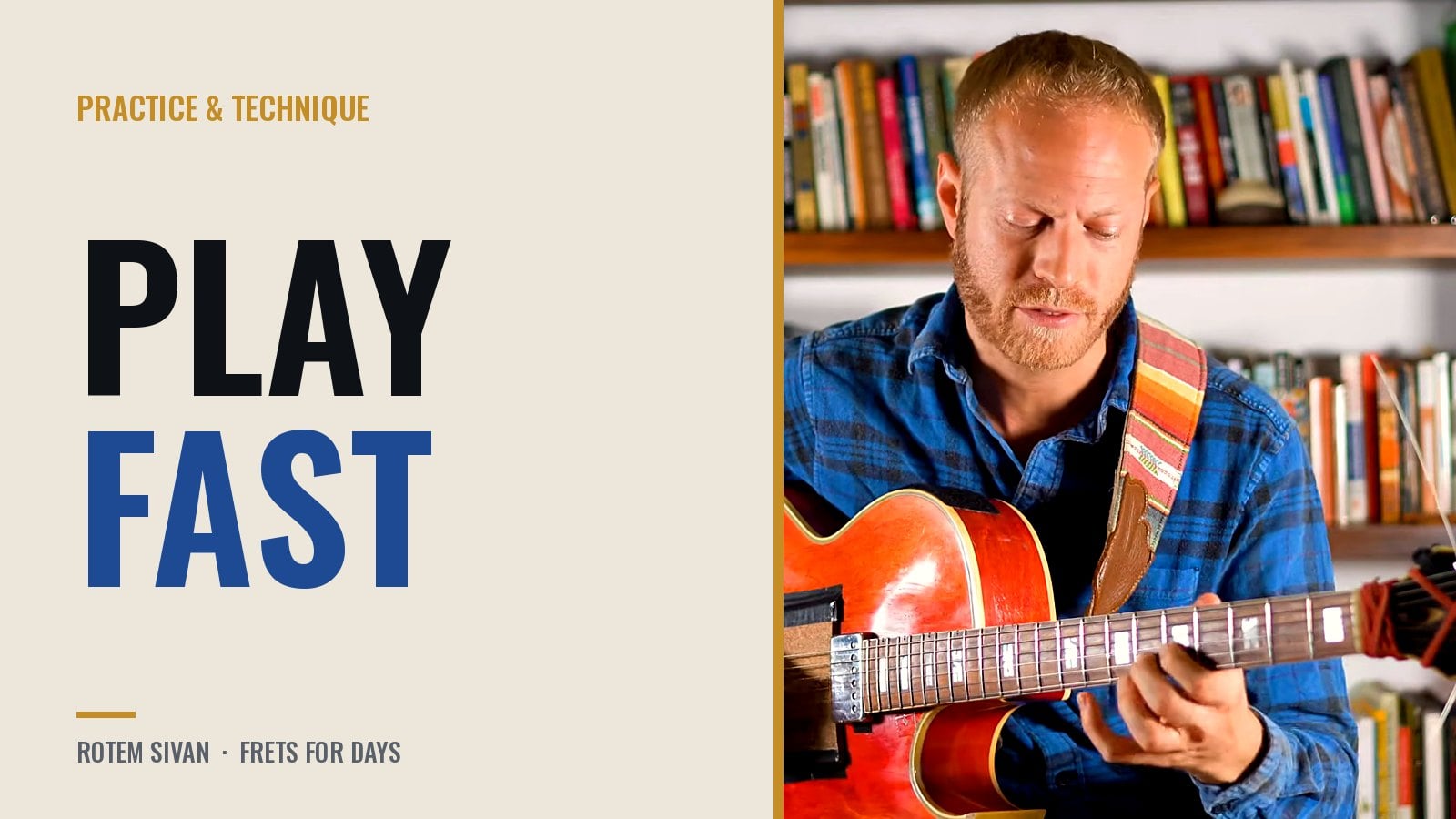
To play fast on guitar, stay relaxed and feel the music in bigger chunks, then build speed with controlled motion exercises. Slow tricky lines down until you can really hear them, anticipate the chord changes before they arrive, and practice your picking hand on its own every day so both hands stay in sync.
When I was studying in school, I was very concerned that I’d never be able to play fast. I was quite worried I just wasn’t talented enough. The five points in this post, and in the video below, are a conclusion of my time in New York, studying and playing with a lot of people.
Trick 1: Tell yourself it’s slow
Take a deep breath and tell yourself it’s slow, very slow. Fast tempos get easier when you’re not stressed and you feel the tune in bigger chunks.
In the video I play the A section of Cherokee at 320 BPM. That’s kind of fast. Instead of filling every chord with eighth notes and 16th notes and being stressed about it, I take a deep breath, relax, and fill it in half time.
I’m still playing some eighth notes, some 16th notes, some triplets. The difference is that I’m filling the groove in a more relaxed way. There’s time and there’s space. I think that not being stressed, and feeling the bigger chunks, really helps you play it better.
Trick 2: Practice a legato motion exercise
To play fast, you also have to practice fast. This introductory legato exercise combines hammer-ons and pull-offs, and the rule of thumb is simple: hit one string, get two notes.
I use a lot of alternate picking, but I also use a lot of legato. There are quite a few variations of this exercise. You can do ascending and descending hammer-ons, or ascending and descending pull-offs. Here’s the one I show in the video:
- Ascend with a hammer-on. Use your first and second fingers on frets five and six. Hit the string once and play two notes.
- Descend with a pull-off. Shift direction, hit the string, and pull off to get the second note.
- Change the fingers. Do the same thing with fingers one and three, then one and four, then one and four stretched to a major third and to a fourth.
- Put it in time. Play all of these in tempo with a click or a groove. You can also play them in groupings of three or four.
Whatever variation you play, keep it as balanced and in control as possible. The groupings help, because once you know these shapes, you can change the shape later on. That’s where the music starts.
If you want a daily routine for the motions under your playing, 5 Steps to Freedom is a short video course on exactly that: five motions in three to five minutes a day, including a “mini gym” for the fretting hand.
Trick 3: Slow it down so your ears learn it
Muscle memory isn’t enough. Slow a fast line way down, listen, and let your system learn the information. Once you can hear it clearly, you can speed it up and play it accurately.
A lot of times, when we need to play something fast, we memorize the physical motion: the kinesthetic memory, the muscle memory of it. But that’s not enough. We need to hear it clearly and really tag those colors. If I’m playing a Parker melody without paying attention, it’s much harder to really hear it and play it accurately.
If I’m slowing it down and listening, I’m actually learning what’s happening there. And therefore, I could fast forward and play it much faster because I understand what I’m saying.
Rotem Sivan
If you want to train your ears further, my post on how to play guitar by ear goes there.
Trick 4: Anticipate where the music is going
Listen to the tension and release, and imagine the next sound before it arrives. Planning ahead a little gives you more time, even at fast tempos.
A lot of times when we’re playing music, we’re in the moment, playing the chord change, and the changes keep bumping and jumping on us. A good way to buy a little more time is to anticipate and imagine where you’re going.
If I’m playing rhythm changes or Cherokee and it’s really fast, I might plan ahead and imagine the sound color that’s coming, like the sound of diminished or the sound of augmented. It doesn’t have to be the exact line. It can be just the sound color. I think of it like a truck coming toward you. It’s a little blurry in the beginning, but the closer it comes, the more clearly you see it: oh, it’s a red truck with this diminished sound. The closer it gets, the more accurately you can hear it and make it happen.
Trick 5: Sync your two hands
Practice your picking hand separately from your fretting hand, starting on the open strings. Split each stroke into two motions, preparing the pick on the string and then releasing, so your hands learn exactly where the strings are.
One of the biggest challenges on guitar is the sync between the right hand and the left hand. It took me quite a while to understand that. If you can’t hit the strings, it’ll be very hard to execute anything. So I started practicing the right hand separately from the left, and I still do it every day. The first thing I do when I pick up a guitar is practice the open strings.
Preparing, releasing, preparing, releasing. When you practice it, you’re teaching your brain and your hands where the strings are. I usually do four options:
- All downstrokes. Slowly. I’ll do it even slower than I show in the video.
- All upstrokes. Same idea, the other direction.
- Down and up. Alternate picking, starting with a downstroke.
- Up and down. Alternate picking, starting with an upstroke.
Then do the same thing, but jump one string. After that, try groupings of two strings, each with the same four variations. Practice with a click, and you can use eighth notes, triplets, quintuplets, sextuplets, all kinds of variations. It’s endless, but you don’t need to do everything. The point is getting your two hands a little more in sync and in control.
Open-string picking is also where Technique & Speed starts. It’s the routine I still play first thing every morning, adapted from what my classical guitar teacher showed me, written out as a PDF in notation and tab.
Try this today: make open-string picking the first thing you do in the morning. I really recommend five to 10 minutes a day. Run all four variations with a click, slowly. Stick with it, because after a week or two you start seeing a very big difference. For the rest of a daily session, my post on building a guitar practice routine picks up from there.
Frequently asked questions
Is legato or alternate picking better for playing fast?
I use both: a lot of alternate picking and a lot of legato. For legato, start with hammer-ons going up and pull-offs coming down, one pick for two notes, and keep it balanced and in control before you play it in tempo with a click.
How long should I practice picking exercises each day?
Five to 10 minutes a day is what I recommend, and do it first thing in the morning. Practice the picking hand on the open strings, preparing and releasing, through all four variations. After a week or two, you start seeing a very big difference.
Does practicing slowly help you play faster?
Yes. Muscle memory alone isn’t enough to play a fast line accurately. When you slow it down and listen, you learn what’s actually happening in the line and hear its colors clearly. Once you understand what you’re saying, you can play it much faster.
How do you keep up with fast chord changes?
Relax and feel the tune in bigger chunks, like filling a fast tune in half time. Then anticipate: listen to the tension and release and imagine the sound color of the next chord, such as diminished or augmented, before it arrives. It doesn’t have to be an exact line.
Pick up the guitar tomorrow morning, take a deep breath, and start with the open strings before you play anything else.



